When and where can you see the northern lights on a Norway road trip?
Dark months, the latitude band, how to read the Kp index and the winter road rules, with no promises. The northern lights on a Norway road trip in 2026.
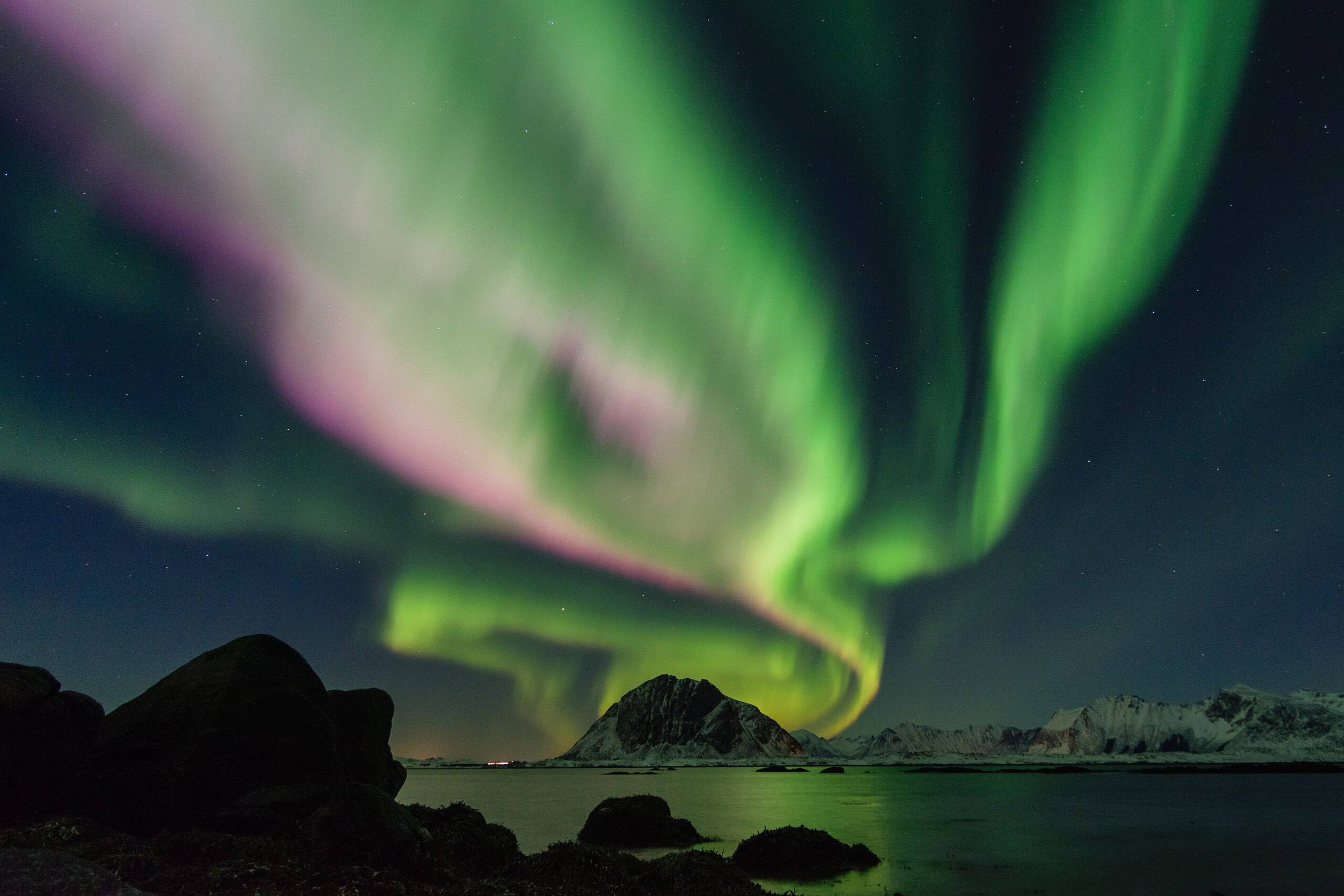
The short answer (status: October 2026): drive north, and go between early September and mid-April. The aurora is there all year, but you only see it against a dark sky, and in summer the midnight sun hides it. Northern Norway lies under the auroral zone, so on a clear, dark night there your odds are good. Cloud is the real enemy, and nobody can guarantee a display on a given night, so build the trip so that it is still a good trip without one.
The northern lights at a glance
| Question | Answer |
|---|---|
| When is it dark enough? | In northern Norway, in practice from early September to mid-April |
| Best time in the season | Around the equinoxes (September and March) geomagnetic storms become more frequent |
| Where? | Under the auroral oval, roughly 60–75° latitude, which covers northern Scandinavia |
| How often? | Troms and Finnmark: if not every clear night, then at least every other one. Southern Norway: a few times a month |
| Biggest obstacle | Cloud. Also the days around full moon, and town lights |
| Forecast | Kp index (0–9, every three hours); NOAA's 30–90-minute forecast; Yr's "Other conditions" tab |
| Guarantee | None. Treat every sighting as a bonus |
What you are actually looking at
The northern lights are air that glows. When the solar wind hits the air around the Earth, the air can start to shine, at a height of 80 to 500 kilometres. The light is often green, but it can also be red or violet, and it may move in waves or hang still like a glowing cloud.
The US space weather service NOAA describes the mechanism: accelerated electrons follow the Earth's magnetic field down to the polar regions and collide with oxygen and nitrogen atoms. That is why the lights sit in a ring around each magnetic pole and not over the whole planet.
When: it is about darkness
The aurora does not switch off in summer. You just cannot see it. NOAA puts it plainly: the sky must be clear and dark, so during the summer months at auroral latitudes the midnight sun prevents observations.
The Tromsø Geophysical Observatory (UiT The Arctic University of Norway) gives the practical window for northern Norway as early September to mid-April. Strong displays can be seen against a fairly light sky too, and in Tromsø it is not unusual to see the aurora against an evening sky in August.
Within that window, the equinoxes stand out. NASA notes that both spring and autumn bring an increase in geomagnetic storms, so as northern nights grow longer, the September equinox also brings a good season for the aurora. For a road trip that is useful: September and March combine darkness with roads that are less wintry than in midwinter.
Polar night is not required. In Tromsø, the Norwegian Meteorological Institute's sunrise service gives no sunrise at all from 28 November 2026 to 14 January 2027. In Bodø, on 21 December 2026, the sun rises at 11:36 and sets at 12:24. That means many dark hours, but also short driving days. The aurora itself still depends on the sky, not on the date.
On a given night, the Tromsø observatory says activity often begins late in the afternoon or in the evening and frequently goes on far into the night. NOAA describes the arcs beginning to twist and sway late in the evening, near midnight, sometimes expanding to fill the whole sky. That is the peak of an auroral substorm.
If you are choosing between a light summer trip and a darker autumn one in the islands, see Lofoten in June or September?.
Where: the latitude band
NOAA says the best place to watch is under an oval-shaped region between about 60 and 75 degrees north and south. During large storms the aurora extends towards the equator and can be seen as far south as Europe.
The Tromsø observatory describes the zone as a belt about 2,500 km from the magnetic pole, running over northern Scandinavia, Iceland and the southern tip of Greenland. Its rule of thumb for frequency:
- Troms and Finnmark: if not every clear night, then at least every other one;
- southern Norway: a few times a month;
- Central Europe: a few times a year.
For a road trip, that means Northern Norway: Lofoten, Senja, Tromsø and Finnmark. The observatory adds that cloud is the main obstacle in northern Norway, which makes inland areas better than the coast, and that you should get away from towns and villages with a lot of light.
That is where a vehicle helps. If the coast is under cloud, a clear sky may be an hour's drive inland. Check the cloud forecast first and the aurora forecast second.
The solar cycle: a high phase, not a promise
On 15 October 2024, NASA and NOAA announced that the Sun had reached its solar maximum period, and expected the maximum phase to last another year or so before the declining phase. They also note that fairly significant storms are often seen during the declining phase.
Whether winter 2026/27 counts as maximum or declining phase is not stated on the official pages we checked today, so we treat it as unknown. It does not change the plan: a dark, clear night far north still matters more than the cycle.
How to read the forecast
- Kp index. NOAA's planetary K-index measures disturbance of the Earth's magnetic field on a scale of 0 to 9, from the largest fluctuations in a three-hour interval. 1 is calm, and 5 or more is a geomagnetic storm (Kp 5 = G1, minor).
- The 30-minute forecast. NOAA's OVATION-based forecast looks 30 to 90 minutes ahead, the time the solar wind takes from the observation point to Earth. When the solar-wind data are missing, it falls back on Kp and has no lead time. A bright aurora can be seen from as far as 1,000 km away when conditions are right.
- Yr. The "Other conditions" tab for a place on yr.no shows the aurora activity, the cloud cover and the Kp index side by side.
Kp is a planetary average, not a local promise. No official source we found gives a Kp value that guarantees a sighting at a particular place in Norway. A low Kp under a clear sky in Troms can beat a high Kp under cloud.
Winter driving: the part that costs money
An aurora trip is a winter-road trip, even in September and March in the north.
- Tread depth. In Nordland, Troms and Finnmark, the winter minimum of 3 mm applies from 16 October to 30 April inclusive. Studded tyres may be used in the same period, and outside it when the weather and road surface make it necessary. Whatever the date, the driver is responsible for enough grip.
- Convoys. On mountain passes in bad weather, cars may have to drive together behind a lead vehicle. Check road status at dit.vegvesen.no or call +47 22 175 175.
- Stopping. Stopping is not allowed in tunnels, on the crest of a hill or anywhere with poor visibility, and headlights must be on at all times.
The Norwegian encyclopedia's article on aurora tourism names the problem: dangerous driving and illegal parking along narrow, dark and slippery roads. Do not stop on the carriageway because the sky lit up. Drive on to a proper lay-by or car park, and find it in daylight if you can.
The tyre and chain rules for heavier vehicles, and what a hired camper comes with, are in Renting a camper in Norway. Mountain-road closures are covered in Driving in Norway, and where you may park for the night in Campervan overnight parking.
What to expect, honestly
- Some nights will be cloudy, and some clear nights will be quiet. Plan several nights in the north, not one.
- Keep the days worth having on their own: fjords, coast roads and short hikes in the light you get.
- Leave the evening flexible. Sleep somewhere you can step outside without driving, and away from street lights.
- A good plan saves money and the holiday: a trip built only around one aurora night is the trip most likely to disappoint.
What this article leaves out
This page covers when and where. Our guides cover the winter driving and the northern route in detail:
- Norway camper handbook: the winter chapters, with tread depths, studs and chains, the motorhome exemptions up to 7,500 kg, city stud fees, convoys and daylight tables for Bodø, Tromsø and Nordkapp;
- Lofoten & Vesterålen: 7-day route: the route day by day, with light and darkness dates for the islands and the shoulder months.
FAQ
Can you see the northern lights in Norway in summer?
Hardly. The aurora is there, but the midnight sun keeps the sky too light. In northern Norway the practical window is early September to mid-April, although strong displays are sometimes seen against an August evening sky in Tromsø.
What Kp index do I need?
There is no official threshold for a given place. Kp runs from 0 to 9, and 5 or more is a storm. Under the auroral zone in northern Norway, darkness and a clear sky matter more than a high number.
Can you see the northern lights in Oslo or southern Norway?
Sometimes. The Tromsø Geophysical Observatory gives a few times a month for southern Norway, against at least every other clear night in Troms and Finnmark.
Do I need winter tyres in October?
In Nordland, Troms and Finnmark, the 3 mm winter tread minimum applies from 16 October. Norway's rules for vehicles over 3,500 kg differ. Check the Statens vegvesen page and ask the rental company what the vehicle has.
Sources
- tgo.uit.no/articl/aurora.html · accessed 7 October 2026
- spaceweather.gov/phenomena/aurora · accessed 7 October 2026
- science.nasa.gov/image-article/apod-2011-september-23-september… · accessed 7 October 2026
- lille.snl.no/nordlys · accessed 7 October 2026
- api.met.no/weatherapi/sunrise/3.0/sun · accessed 7 October 2026
- api.met.no/weatherapi/sunrise/3.0/sun · accessed 7 October 2026
- science.nasa.gov/science-research/heliophysics/nasa-noaa-sun-re… · accessed 7 October 2026
- spaceweather.gov/products/planetary-k-index · accessed 7 October 2026
- spaceweather.gov/products/aurora-30-minute-forecast · accessed 7 October 2026
- yr.no/en/other-conditions/1-305409/Norway/Troms/Tromsø/Tromsø · accessed 7 October 2026
- vegvesen.no/en/vehicles/own-and-maintain/tyre-requirements · accessed 7 October 2026
- vegvesen.no/en/traffic-information/traffic-information/drive-sa… · accessed 7 October 2026
- snl.no/nordlysturisme · accessed 7 October 2026